How to Test Glow Plugs: Safe Methods and Readings
- Written by
- Diesel Glow Plug Editorial Team
- Reviewer
- Diesel Glow Plug Editorial Team
- Review date
- First published
Testing glow plugs means checking whether each plug's heating circuit works, using the method and the reading in your own service manual. Work safely: engine off and cool, no fuel lines opened, battery handled as your manual says. Never connect a plug to a supply its rating does not allow, because Bosch lists excessive voltage as the leading cause of failure.
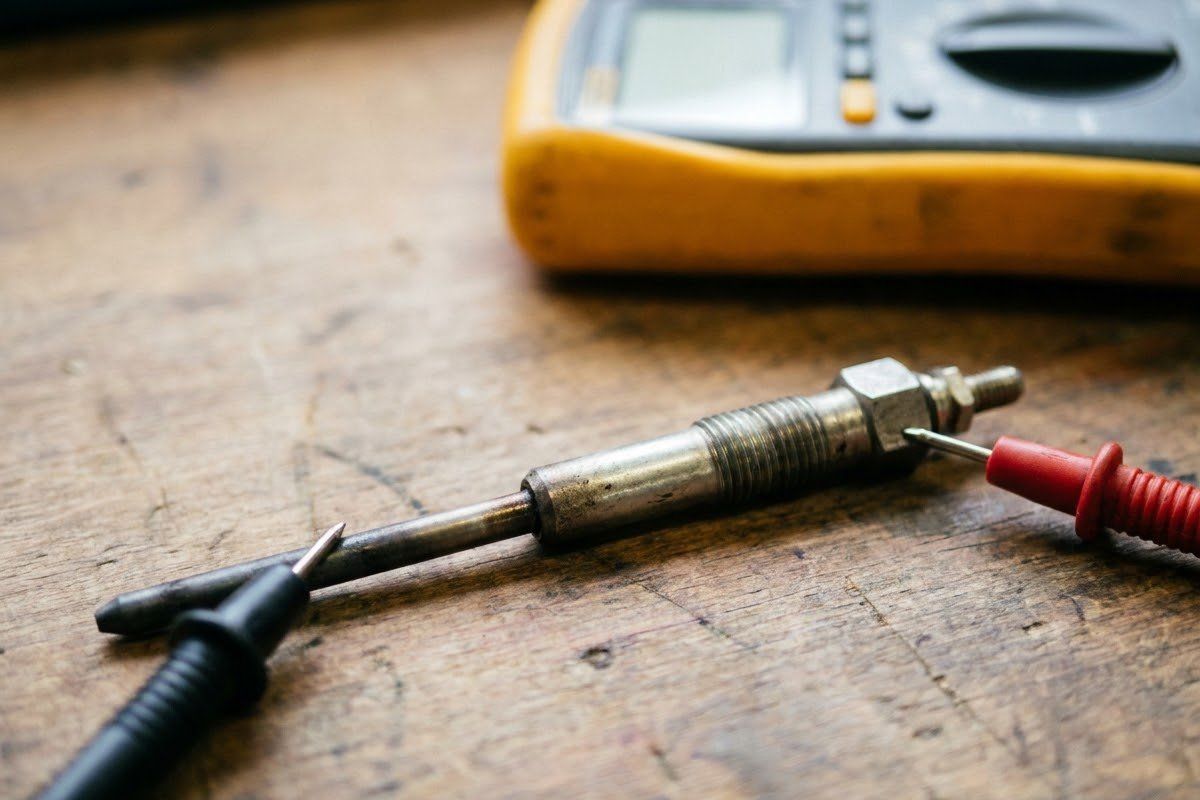
This is part of: Diesel Glow Plugs: What They Do, Failure Signs and Replacement
Testing glow plugs means finding out whether each plug’s heating circuit works. This guide is part of the glow plug series. It explains the safe approach and how to think about results; the exact procedure and values must come from your owner’s or service manual.
Short answer
Test with the method in your service manual, compare to its value, and do not guess. This page gives no resistance value, because values differ between plugs and voltages. It also does not tell you whether your engine passes or fails.
Safety: battery, hot engine, no fuel lines opened
Read these rules before touching anything.
- Engine off and cool. Bosch gives a glow plug operating range of 850 to 1,100 degrees Celsius, so a plug that has just been used can be hot.
- Handle the battery only as your manual says, including whether and when to disconnect it.
- Do not open fuel lines. Diesel fuel is flammable; keep sparks and flames away.
- If the vehicle must be raised, never work under it on a jack alone. A Ford dealer bulletin hosted by NHTSA (written for an unrelated F-150 Lightning recall, but carrying Ford’s standard jacking warnings) says never get underneath a vehicle supported only by a jack, to use floor stands, to work on a hard, level surface and to block the wheels that stay on the ground.
- Ventilate. OSHA lists the internal combustion engine among the common workplace sources of carbon monoxide exposure. Do not run an engine in a closed garage or other enclosed space.
- Never apply a supply that exceeds the plug’s rating. Bosch says excessive voltage is the leading cause of glow plug failure.
Warning
Stop and see a qualified technician if a plug will not turn freely, if one breaks, if you smell fuel, if the glow plug light flashes with other warnings, or if the check needs fuel lines opened.
Resistance test with a multimeter
A resistance check measures how easily current can pass through the plug’s heating element. In general terms, a plug that reads as an open circuit has a broken heating path, while a reading you can compare with the maker’s figure tells you whether the plug is within range. Only your manual can say what range applies, and how to connect the meter for your engine.
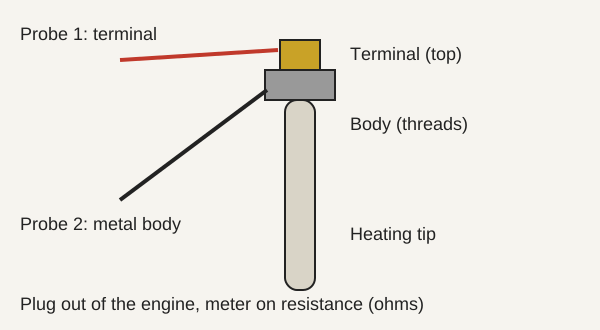
To use a number safely, write down the reading, the temperature of the engine and the conditions, then compare it with the specification in your own documents. Our glow plug resistance check helper makes the comparison from the number you enter and a range you take from your manual.
Reading results: what a value suggests
A single reading is not a verdict. A value outside the manual’s range suggests a plug that needs attention; a value inside it does not prove the whole system works. Ford’s 7.3L diagnostic summary shows the system looks at current, not only resistance: for its California-calibrated system, an open circuit is a current below 4 amps and a short is above 60 amps, with battery voltage between 10 and 14 volts. That is a description of what the engine’s own monitor checks, not a procedure for owners.
Other causes: relay, controller, wiring
A good plug can still fail to heat if something upstream is wrong. Bosch says the controller switches current to the plugs for a set time, and that a failed controller can apply current too long and overheat them. Bosch’s fault-diagnosis poster also lists premature injection and nozzles with carbon deposits as causes of plug damage. Ford’s 7.3L supplement lists a glow plug relay, oil temperature and barometric pressure sensors in its system. The 7.3 Powerstroke glow plug relay page covers one engine’s relay.
If the light is the problem you are chasing, start with the glow plug light guide.
When to replace the set
Bosch recommends replacing all glow plugs at the same time. If a test shows one failed plug, the rest may be close behind. Replacement is a job for a technician when plugs are seized or the engine is hard to reach; the cost factors guide shows what drives the price.
Answers to common questions
Can I test glow plugs without removing them?
Sometimes, depending on the engine and what your service manual says. Electrical checks at the plug connector may be possible in place, while a visual check of the tip requires removal. Removal carries risk: Bosch notes that a seized plug can break when loosened, which would require time-consuming cylinder head disassembly. If a plug will not turn freely, stop and see a technician.
What is a good reading?
Only your engine's manual or the plug maker's data can say. Bosch's brochure describes measuring a plug's resistance with an ohmmeter and subtracting the meter's own offset, but values differ between plugs and voltages, so this site publishes none. Use the free resistance helper to compare your measured value to the number from your manual; it does not decide pass or fail for you.
Do I replace all plugs together?
Bosch recommends it. Its FAQ says that if one glow plug fails, chances are the others will not be far behind, and that replacing all at the same time minimizes vehicle down-time and labor cost. Your manual or a technician can confirm what is right for your engine, particularly if a plug broke or seized.
Could the problem be something other than the plugs?
Yes. Bosch notes that a failed controller can leave current applied too long and damage the plugs, and its fault-diagnosis poster lists premature injection and nozzles with carbon deposits among causes of damaged plug tips. Relays, wiring and the control module can fault too. Testing a plug alone may not find the cause, so use the maker's diagnostic steps.
Is it safe to touch a glow plug to the battery to see if it glows?
Not as a general rule. Bosch lists overvoltage, such as 24 volt starting assistance or a plug of the wrong voltage, as causes of plug damage. Plugs also get extremely hot: Bosch gives an operating range of 850 to 1,100 degrees Celsius. Follow your manual's procedure, or have a qualified technician perform the test.
Sources
- Bosch Auto Parts (US): Glow Plugs, technical information and FAQboschautoparts.com
- Bosch: Glow plugs Duraterm, Duraterm HighSpeed and DuraSpeed (brochure)boschaftermarket.com
- Bosch: Fault diagnosis at a glance, glow plug faces (poster)boschaftermarket.com
- Ford: 2000 MY OBD System Operation Summary for 7.3L Diesel Enginefordservicecontent.com
Worth reading next
- Diesel Glow Plugs: What They Do, Failure Signs and Replacement
Diesel glow plugs explained: what a glow plug does, how the wait-to-start sequence works, failure signs, testing and when replacement belongs to a shop.
- 7.3 Powerstroke Glow Plug Relay: Function, Failure Signs, Testing
What the 7.3 Powerstroke glow plug relay does, how its failure can look, and the safe order for checking it before replacing glow plugs or parts.
- 7.3 Powerstroke Glow Plugs: Overview and Replacement Notes
7.3 Powerstroke glow plugs: how Ford describes the system, the wait-to-start light, testing and replacement cautions, and where to confirm fitment.
- Glow Plug Light: What It Means and What to Do When It Flashes
What the diesel glow plug light means, how normal wait-to-start differs from a fault, and what to check or do when it flashes or stays on.
- Glow Plug Replacement Cost: What Drives the Price
What drives glow plug replacement cost: plug count, engine access, seized plugs and labor. Learn how to get a quote, with no price claims here.
- What Does a Glow Plug Do?
What does a glow plug do? It pre-heats a diesel's combustion chamber for cold starts. See the key-on to afterglow sequence and why gas engines skip it.