What Does DEF Do? How SCR Cuts Diesel NOx
- Written by
- Diesel Glow Plug Editorial Team
- Reviewer
- Diesel Glow Plug Editorial Team
- Review date
- First published
- In
- DEF
DEF is injected into the exhaust of a selective catalytic reduction (SCR) system to control nitrogen oxide (NOx) emissions from a diesel engine. The system is calibrated to DEF at 32.5 percent urea, so the right concentration matters. The sources we opened do not give the chemistry step by step, so this page sticks to what EPA and makers state.
Safety first
DEF is not fuel and must not go in the fuel tank. Follow your manual’s handling notes, refill in a ventilated area, and see a qualified technician for DEF warnings or a derate that does not clear after refilling.
This is part of: What Is DEF (Diesel Exhaust Fluid)? Complete Owner Guide
DEF does one job: it lets a diesel’s SCR system control nitrogen oxide (NOx) emissions. It is the working fluid of the system. For the big picture, start with what DEF is; this page is the “what does it do” answer. Check your owner’s manual for the details of your own vehicle.
What does DEF do?
It reduces NOx. EPA describes SCR as relying on injecting an aqueous urea solution, DEF, into the exhaust to control NOx emissions. EPA calls NOx a major contributor to air quality nonattainment. The step-by-step chemistry is not in the EPA pages we opened, so we do not describe it here.
How do the SCR catalyst and injection fit together?
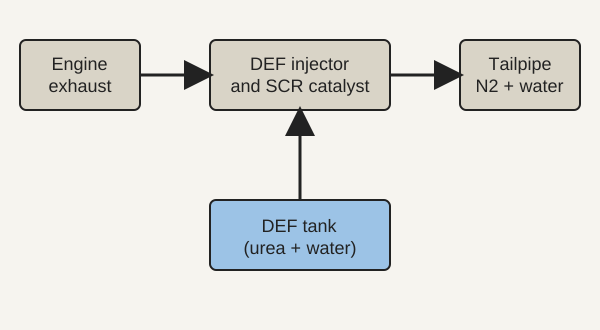
DEF sits in its own tank. The system injects it into the exhaust and the SCR catalyst does the NOx work. EPA says the operator must replenish DEF routinely, with DEF meeting the engine maker’s specification. The vehicle monitors the system for low DEF and failures and warns the driver.
Why did EPA rules lead to DEF?
EPA says nearly all on-road diesel trucks since 2010 have used DEF to reduce NOx emissions, and that vehicles using DEF must meet EPA Tier 2, Tier 4 or 2010 emissions standards, depending on vehicle type and model year. We do not summarize the standards themselves.
Why does dosing matter?
Dosing matters because the system is calibrated. EPA says SCR systems are calibrated to 32.5 percent urea, the ISO 22241-1 concentration, and that other fluids could significantly raise NOx emissions. The system monitors for poor DEF and can limit performance. EPA describes the speed and power loss, or derate, that can follow, down to as low as five miles per hour in some cases. Do not dilute DEF. See what DEF is made of.
What this means in practice
- Treat DEF as a consumable, like oil: check the level on the schedule your manual suggests and top up before the gauge or a message asks you to.
- Use only the fluid your manual names, and fill only the DEF filler.
- Do not ignore a DEF or emissions message. Read what the manual says it means.
- Keep a record of when you topped up, so a sudden change in use stands out.
Questions to ask a technician: what is the normal DEF use for this engine in my kind of driving, and what does this warning message mean on this model?
Related guides
For storage, see DEF shelf life. To buy it, see buying DEF. The DEF consumption estimator helps you plan how much you use.
In cold weather, does DEF freeze explains what to expect.
Answers to common questions
Does DEF improve mileage?
EPA describes DEF's purpose as controlling NOx emissions through SCR, and the system is calibrated to a 32.5 percent urea concentration for NOx reduction, not for fuel economy. A Maryland Department of the Environment fact sheet says heavy-duty engines that use SCR receive a fuel economy improvement of up to 5 percent because the engine can be optimized around it. That is a statement about heavy-duty SCR engines, not a promise for your vehicle; your maker's documentation is the place to check.
Can I bypass DEF?
We give no bypass information. EPA says the SCR system must be designed to prevent tampering or bypassing DEF usage, and its guidance letter discusses what counts as tampering under the Clean Air Act. If you have a DEF or derate problem, take it to a qualified technician or the engine maker, who can address the real fault.
Is DEF harmful?
Follow your manual's handling instructions. The 2020 Mazda CX-5 manual calls DEF a colorless, transparent, odorless, nonpoisonous solution, but also says to wash your mouth out with plenty of water and seek medical attention if it gets in your mouth. The 2022 Ford F-650/F-750 manual says an ammonia odor may be noticed on refilling and to refill with ventilation.
What is SCR?
SCR stands for selective catalytic reduction. In EPA's description, the system injects DEF into the exhaust to control NOx emissions, and the DEF is stored in a tank on the equipment that the operator must replenish. The vehicle monitors the system, and a warning light tells the driver when DEF is low or the system has a fault.
Why does dosing matter?
The system works from an assumed concentration. EPA says SCR systems are calibrated to 32.5 percent urea, and that fluids other than the maker's DEF could contribute to a significant increase in NOx emissions. Diluted or wrong fluid can also trigger monitoring and performance limits. Use only the DEF your manual specifies and do not add water.
Sources
- EPA: Diesel Exhaust Fluidepa.gov
Worth reading next
- What Is DEF (Diesel Exhaust Fluid)? Complete Owner Guide
What diesel exhaust fluid (DEF) is, which diesels use it, the 32.5 percent urea spec, and where to read about freezing, shelf life and buying it.
- Where to Buy DEF: Pump, Jug and Bulk, What to Check
A vendor-neutral guide to buying DEF as pump, jug or bulk: what to check on the label, the ISO 22241 spec, and how to fill safely. No brands or prices.
- DEF Shelf Life: How Long It Lasts and How to Store It
How long DEF lasts depends on the maker and storage. See what Ford and Mazda manuals say about temperature, sunlight, a two-year limit and containers.
- Does DEF Freeze? Temperature, Thawing and Winter Use
DEF freezes at about 12 F (-11 C). Learn what Ford, Ram and Mazda manuals say about heated tanks, frozen DEF, overfilling and winter storage.
- What Is DEF Made Of? Urea, Water and Purity
DEF is a 32.5 percent urea solution in water. See what that means, why purity and dilution matter to SCR systems, and what manuals say about handling.