Diesel Engine Maintenance Checklist for Owners
- Written by
- Diesel Glow Plug Editorial Team
- Reviewer
- Diesel Glow Plug Editorial Team
- Review date
- First published
Diesel engine maintenance means following the service schedule in your owner's manual: change oil and filters on time, drain or replace the fuel filter and water separator, keep the air filter clear, top up DEF if your vehicle uses it, and watch the glow plug system and coolant. Intervals differ by engine, so use your own manual, not a general number.
This is part of: Diesel Engines Explained for Owners
Diesel engine maintenance is the set of checks that keep a diesel starting, clean and protected. This page is a checklist for owners, not a service manual; the diesel engine overview explains the engine itself.
Safety first
Most diesel service touches fuel, hot parts, the battery or a raised vehicle. Before any hands-on check, read this block.
- Work with the engine off and cool. Ford warns that fuel may ignite if the water separator is drained while the engine is running or the vehicle is moving.
- No open flame, sparks or smoking near fuel.
- Never get underneath a vehicle supported only by a jack. A Ford dealer letter hosted by NHTSA (written for a different vehicle, but the warning is general) says the jack could unintentionally lower, and tells technicians to support the vehicle with floor stands, to raise it only on a hard, level surface and to block the wheels that stay on the ground.
- Ventilate. OSHA lists the internal combustion engine as one of the most common workplace sources of carbon monoxide and lists diesel engine operators among people who may be exposed. Never run an engine in a closed garage.
- Disconnect the battery only where your manual says to, and follow its steps.
Warning
Stop and see a qualified technician for: a flashing glow plug or engine light with warning messages, a fuel leak, a seized or broken glow plug, a DEF or derate warning, a WATER IN FUEL light that returns after draining, or any job that needs fuel lines opened.
Follow your manual: interval tables vary
Maintenance intervals differ by engine and by how the vehicle is used, so your own manual’s schedule is the one that counts. Ford’s documents show the range for its own engines:
| Item | Ford 7.3L (2000 supplement) | Ford 6.0L normal (maintenance tips) |
|---|---|---|
| Oil and filter | 3,000 miles in severe service | Every 7,500 miles |
| Fuel filter | Replace per Service Guide; drain separator every 5,000 miles or when the light comes on | Every 15,000 miles |
These are examples for named engines, not recommendations for yours. Ford defines severe service for the 7.3L as, among other things, towing, sustained high-speed driving at maximum weight in hot weather, frequent or extended idling and frequent short trips of 10 miles or less in freezing weather.
Oil and filters
Use the oil category and viscosity your manual specifies, and change it on time. Ford’s 7.3L supplement says diesel engines require specially formulated oil to resist contamination, and that on that engine oil viscosity matters because oil pressure actuates the fuel injectors. For the choices, see the diesel engine oil guide. Ford also warns not to handle a hot oil filter with bare hands and that continuous contact with used motor oil has caused cancer in laboratory mice, so wash skin with soap and water.
Fuel system: filter and water
The fuel filter and water separator remove water and impurities, and they need attention. On Ford’s 7.3L, the WATER IN FUEL light comes on when about 100 cc (0.2 pints) of water accumulates. Ford says to stop as soon as safely possible, shut off the engine and then drain the filter bowl if the light comes on while running, and that leaving water in the system could cause extensive damage to the fuel injection system.
Fuel quality and storage matter too:
- EPA says all highway diesel vehicles must use ultra-low sulfur diesel.
- Ford’s supplement says diesel fuel must not be stored in a galvanized container, because the fuel dissolves the zinc, which can then deposit in the injectors.
- Do not run out of fuel. Ford says air entering the system makes restarting difficult and the engine may run rough and produce white smoke until it purges the air.
- Never add gasoline, gasohol or alcohol to diesel fuel; Ford calls it a serious fire hazard.
DEF and aftertreatment
If your vehicle has an SCR system, it uses diesel exhaust fluid. EPA says SCR with DEF is on nearly all on-road diesel trucks since 2010, and that DEF-related derates can cut performance as low as five miles per hour. Learn where DEF goes and what your warnings mean in the DEF guide. Do not try to bypass the system; EPA says it must be designed to prevent tampering.
Cooling, belts, air filter and the glow plug system
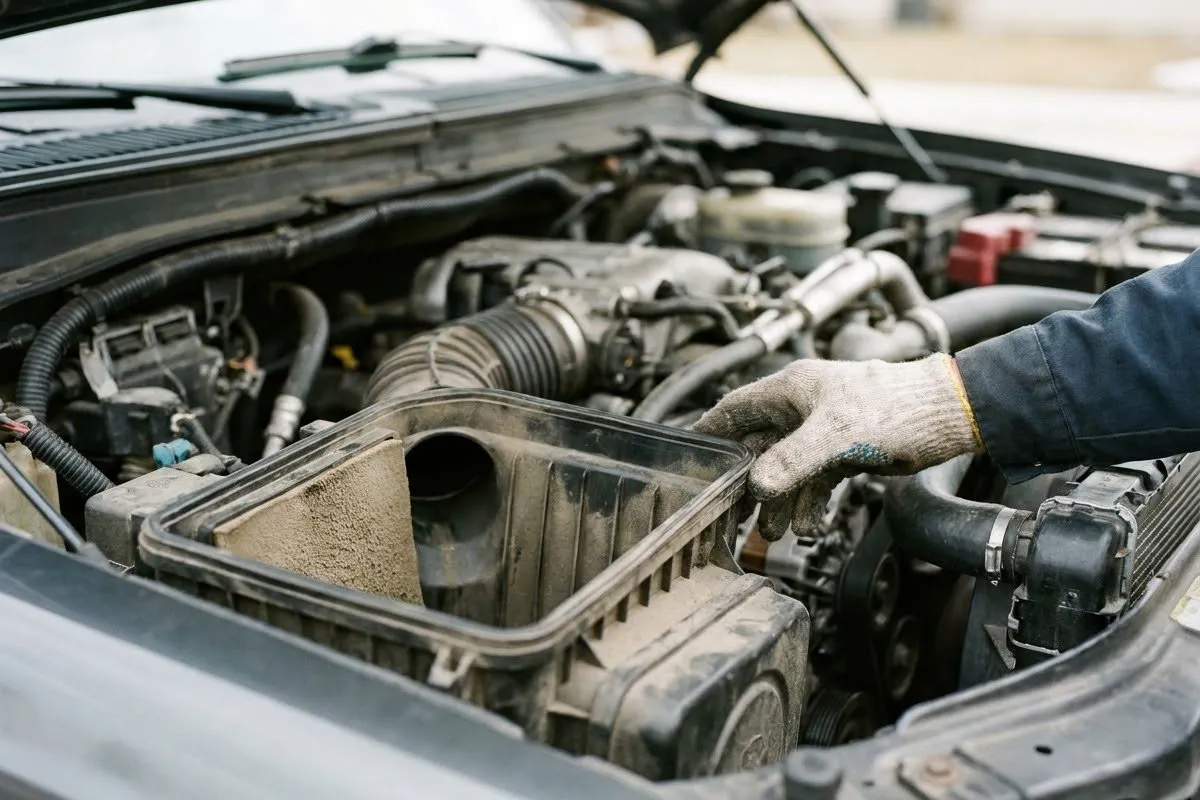
- Air filter. On Ford’s 7.3L, a restriction gauge on the air cleaner shows when the filter is clogged, and Ford says engine performance and fuel economy are adversely affected at maximum restriction.
- Cooling and belts. Ford’s 7.3L supplement lists lack of coolant, a dirty cooling system, a sticking thermostat and a slipping or missing drive belt among causes of an engine running hot.
- Glow plug system. NGK says glow plugs have no mandatory change interval but can deteriorate, and recommends a check before winter. Watch for slow or hard starting and an unusual glow plug light, then read the glow plug guide and how to test glow plugs.
Winter prep
Cold weather adds checks for fuel, starting and the block heater. Ford’s 7.3L supplement says below 20 degrees Fahrenheit Number 2-D fuel may thicken enough to clog the filter and recommends keeping the tank at least a quarter full at 32 degrees Fahrenheit or below. See cold-weather diesel starting.
What to leave to a shop
Leave to a qualified technician anything that opens fuel lines, any work that needs the vehicle raised and you are not equipped to support it on floor stands, seized or broken glow plugs, and emissions-system warnings. This site does not offer repairs or sell parts.
Answers to common questions
How often should a diesel be serviced?
Follow the schedule in your owner's manual; it differs by engine and by use. Ford's own documents show the spread: the 7.3L supplement calls for oil changes every 3,000 miles in severe service, while Ford's tips for the 6.0L list 7,500 miles in normal service. Ford's 7.3L list of severe service includes towing, extended idling and frequent short trips in freezing weather, so check which schedule your manual applies.
Can I change a fuel filter myself?
Only if your manual describes it as an owner task and you can do it safely. Fuel is flammable, and Ford notes that air entering the fuel system during a filter change can make the engine run rough and smoke white until it purges. Ford also warns that fuel may ignite if a separator is drained while the engine is running. If unsure, leave it to a technician.
What are signs I need service?
Common prompts are a WATER IN FUEL light, an air filter restriction indicator, hard starting, a glow plug or wait-to-start light that behaves oddly, or a DEF warning. Ford's 7.3L supplement also says an engine that suddenly gets noisy or runs poorly after a fuel fill could be using substandard fuel. Do not diagnose by guesswork; see your manual or a technician.
Do glow plugs need regular replacement?
No mandatory interval. NGK says that, unlike spark plugs, car makers do not set mandatory change intervals for glow plugs, though performance can decline over time. NGK recommends having them checked before winter. Check your manual, and see a technician if starting gets harder in the cold or the glow plug light behaves differently than before.
Does my diesel need DEF?
Only if it has an SCR emissions system. EPA says SCR with DEF is on nearly all on-road diesel trucks since 2010. If yours takes DEF, keep it topped up: EPA notes that DEF-related derates can limit a vehicle's performance to as low as five miles per hour. Your manual shows where DEF is added and what the warning lights mean.
What should I leave to a shop?
Anything that opens fuel lines, needs the vehicle lifted, involves a seized or broken glow plug, or follows a flashing warning light with messages. Bosch notes a seized glow plug can break off in the head, which would require time-consuming cylinder head disassembly. If in doubt, stop and ask a qualified diesel technician.
Sources
- Ford: 7.3L Power Stroke Diesel Supplement to the Owner Guide (2000)fordservicecontent.com
- Ford: Power Stroke Diesel Operating, Maintenance and Care Tips (6.0L and 6.4L)fordservicecontent.com
- US EPA: Diesel Exhaust Fluidepa.gov
- Bosch Auto Parts (US): Glow Plugs, technical information and FAQboschautoparts.com
- Bosch: Glow plugs Duraterm, Duraterm HighSpeed and DuraSpeed (brochure)boschaftermarket.com
Worth reading next
- Diesel Engines Explained for Owners
What a diesel engine is, how it ignites fuel without spark plugs, which parts matter to owners, and where to read next on glow plugs, DEF, oil and fuel.
- Diesel vs Gas Engines: Differences That Matter to Owners
Diesel vs gas engine compared for owners: ignition, fuel, emissions equipment, cold starts and upkeep, with sources and no price claims.
- Does a Diesel Engine Have Spark Plugs? (No, Here Is Why)
Diesel engines have no spark plugs because compression ignites the fuel. See what glow plugs do instead and how glow plugs differ from spark plugs.
- How a Diesel Engine Works: The Four-Stroke Cycle
How does a diesel engine work? Follow the four strokes of intake, compression, power and exhaust, and see where injection, glow plugs and turbo fit.