Does a Diesel Engine Have Spark Plugs? (No, Here Is Why)
- Written by
- Diesel Glow Plug Editorial Team
- Reviewer
- Diesel Glow Plug Editorial Team
- Review date
- First published
No, a diesel engine does not have spark plugs. It ignites fuel by compression: air is squeezed until it is hot enough that injected fuel ignites by itself. Many diesels do have glow plugs, which are electric heaters that warm the combustion chamber to help cold starts, but they do not create a spark.
This is part of: Diesel Engines Explained for Owners
A diesel engine has no spark plugs, and the reason is built into how it works. For the full picture of the engine, see the diesel engine overview.
Short answer: no, diesels ignite fuel by compression
A diesel ignites fuel with the heat of compressed air, so it has nothing to spark. A US Department of Energy booklet says gasoline engines start the explosions with sparks from spark plugs, whereas in diesel engines fuel ignites on its own. The Department’s engine basics page describes the sequence: only air is drawn in and compressed, then fuel is sprayed into the hot compressed air, causing it to ignite. The stroke-by-stroke version is in how a diesel engine works.
What glow plugs do instead
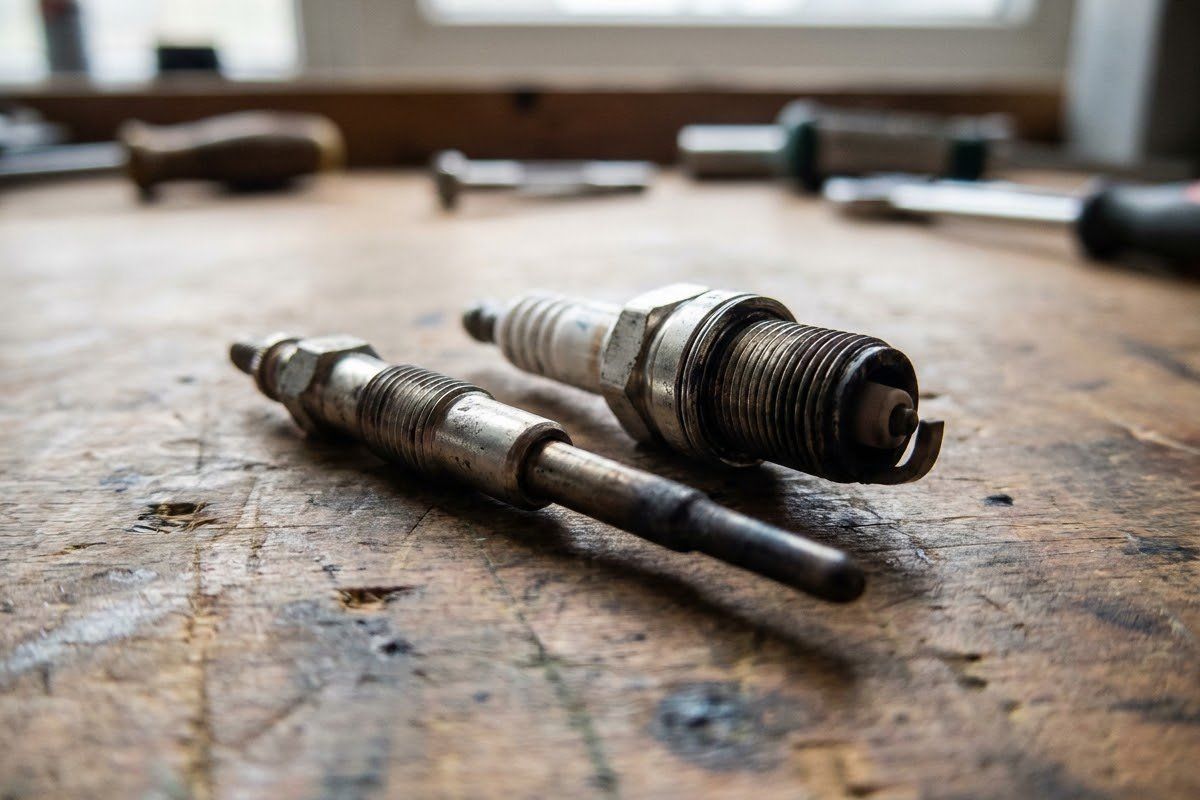
Glow plugs do not replace the spark. They add heat when the engine is cold. Bosch says diesel engines rely on the heat of highly compressed air to ignite a precise amount of fuel, and that in low temperatures, cold intake air and cold cylinder walls hinder reaching the necessary starting temperature. Glow plugs then act as an additional heat source to bring the intake air up to it.
That is why a diesel can have no spark plugs and still have plugs in the cylinder head. The glow plug guide covers the types and failure signs, and what does a glow plug do covers the sequence from key-on to afterglow.
Glow plug versus spark plug
The table in this page’s comparison block sets the differences side by side. The key point: a spark plug is the ignition source on every cycle of a gasoline engine, while a glow plug is a heater that helps a cold diesel reach the temperature at which compression can do the igniting.
NGK adds one practical difference: unlike spark plugs, car makers do not set mandatory change intervals for glow plugs, even though performance can deteriorate with time. Your owner’s manual still governs any service schedule for your vehicle.
Common confusion: gas-engine plugs in a diesel
People mix these parts up because both screw into the cylinder head and both are called plugs. They are not interchangeable and a gasoline spark plug has no job in a diesel. The risky mix-ups are with fuel rather than plugs: Ford’s 7.3L supplement warns against adding gasoline, gasohol or alcohol to diesel fuel because it creates a serious fire hazard.
Warning
Stop and see a qualified technician if gasoline or the wrong fuel has gone into a diesel, if you see a fuel leak, or if a plug is seized or breaks off in the head. Bosch notes that a seized glow plug can break off in the cylinder head, which would require time-consuming cylinder head disassembly.
For testing, replacement cost and the glow plug warning light, see how to test glow plugs and what the glow plug light means.
What to do with this knowledge
- If someone suggests spark plugs for a diesel, ask which part they mean; they usually mean glow plugs.
- Look in your manual for the glow plug section before buying anything.
- If the engine is hard to start in cold weather, read the glow plug light guide and see a qualified technician for diagnosis.
Common mistakes: buying gasoline spark plugs for a diesel, and assuming any heater plug fits any engine. Questions to ask a technician: does my engine use glow plugs, and how is their condition checked?
| Feature | Glow plug (diesel) | Spark plug (gasoline) |
|---|---|---|
| What it does | Adds heat to help the engine start in cold conditions | Creates the spark that ignites the fuel and air mix |
| Role in ignition | Helper for cold starts; ignition itself comes from compression | The ignition source on every cycle |
| Engine type | Compression-ignition (diesel) | Spark-ignition (gasoline) |
| Replacement interval | No mandatory interval set by car makers, per NGK; follow your manual | Set by the maker; follow your manual |
Do not swap or mix them. A diesel runs on glow plugs for cold starts and compression for ignition, and a gasoline engine needs spark plugs; the parts are built for different jobs and are not interchangeable.
Answers to common questions
Do diesel engines have glow plugs?
Many do. Bosch explains that glow plugs act as an additional heat source in low temperatures. Ford's 7.3L Power Stroke owner supplement lists eight glow plugs as part of its glow plug system. Your owner's manual tells you whether your engine has them.
Can a diesel run without glow plugs when warm?
Glow plugs are there as extra heat for cold conditions, and Ford's 7.3L supplement says the glow plug on-time decreases as engine oil temperature and barometric pressure increase. Your manual says how your engine behaves when warm. A failed plug can still hurt a cold start, and NGK says a faulty plug on a car with a particulate filter can lead to a clogged filter. See a technician.
Why is my diesel plug a different shape?
Glow plugs and spark plugs are built for different jobs. Bosch describes its Duraterm glow plugs as using a regulating coil and a heating coil, rather than a spark gap. If you are comparing a part in your hand to a gasoline plug, check your owner's manual or a qualified technician before assuming anything about it.
Can I put gas-engine spark plugs in a diesel?
No. A diesel does not use a spark to ignite fuel, so gasoline spark plugs have no function in it. If you are not sure what is in a socket in your cylinder head, do not guess: consult your owner's manual or a qualified diesel technician rather than forcing a part in.
What happens if I put gasoline in a diesel?
Stop and ask a qualified technician. Ford's 7.3L supplement warns that adding gasoline, gasohol or alcohol to diesel fuel creates a serious fire hazard and causes engine performance problems. Do not start the engine if you realize you have misfueled, and do not try to drain the tank yourself unless your manual describes a safe procedure.
Sources
- US DOE EERE: Just the Basics, Diesel Engine (August 2003)www1.eere.energy.gov
- Bosch Auto Parts (US): Glow Plugs, technical information and FAQboschautoparts.com
- Bosch: Glow plugs Duraterm, Duraterm HighSpeed and DuraSpeed (brochure)boschaftermarket.com
- Ford: 7.3L Power Stroke Diesel Supplement to the Owner Guide (2000)fordservicecontent.com
Worth reading next
- Diesel Engines Explained for Owners
What a diesel engine is, how it ignites fuel without spark plugs, which parts matter to owners, and where to read next on glow plugs, DEF, oil and fuel.
- Diesel Engine Maintenance Checklist for Owners
A diesel engine maintenance checklist covering oil, fuel filter and water, air filter, DEF, glow plugs and cooling, with safety rules and shop triggers.
- Diesel vs Gas Engines: Differences That Matter to Owners
Diesel vs gas engine compared for owners: ignition, fuel, emissions equipment, cold starts and upkeep, with sources and no price claims.
- How a Diesel Engine Works: The Four-Stroke Cycle
How does a diesel engine work? Follow the four strokes of intake, compression, power and exhaust, and see where injection, glow plugs and turbo fit.