How a Diesel Engine Works: The Four-Stroke Cycle
- Written by
- Diesel Glow Plug Editorial Team
- Reviewer
- Diesel Glow Plug Editorial Team
- Review date
- First published
A diesel engine works by compressing air until it is hot enough to ignite fuel, with no spark. In each four-stroke cycle the piston draws in air, compresses it, receives injected fuel that ignites and pushes the piston down, then pushes the exhaust out. Glow plugs add heat only to help cold starts.
This is part of: Diesel Engines Explained for Owners
A diesel engine ignites its fuel with heat from compressed air, so it needs no spark. This page walks through the cycle and the physics behind it. For the owner’s view of the whole engine, start with the diesel engine overview.
Short answer: air is compressed until fuel ignites
In a diesel engine, only air is drawn in and compressed. The US Department of Energy says fuel is then sprayed into the hot compressed air at a measured rate, causing it to ignite. A Department of Energy booklet adds that the fuel ignites as the piston approaches the top of its compression stroke, as the fuel contacts the heated air.
The four strokes: intake, compression, power, exhaust
Most diesel engines are four-stroke engines, meaning four piston strokes make one cycle. The Department of Energy names the four processes as intake, compression, combustion and power stroke, and exhaust.
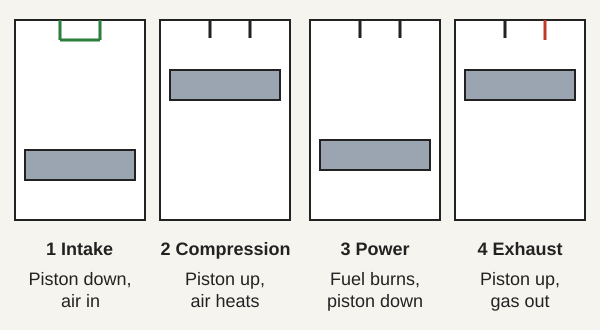
- Intake. The piston moves down, creating space, and draws air into the cylinder. No fuel is present yet.
- Compression. The piston swings upward and squeezes the air. The Department of Energy booklet notes that compressing air heats it at the same time.
- Power. Fuel is injected under high pressure as the piston nears the top. It ignites spontaneously, and the hot gases expand and drive the piston down. This is the stroke that does the work.
- Exhaust. On the return swing, the piston pushes spent gases out of the cylinder, and the cycle starts again with fresh air.
Why compression and heat matter
The heat of compression is what lights the fuel, so the engine must reach a minimum temperature. Bosch states that heating the air to a minimum starting temperature of 850 degrees Celsius is critical for diesel start-up. When the engine is cold, factors such as cold intake air and cold cylinder walls hinder reaching that temperature.
That is the whole reason glow plugs exist. They are covered in the glow plug guide and, mechanism by mechanism, in what a glow plug does. Once the engine is warm, compression alone supplies enough heat.
The Department of Energy booklet also explains why designers wanted high compression: compressing air concentrates fuel-burning oxygen, and a fuel with high energy content per gallon, like diesel, can release more energy per explosion if injected at exactly the right time. That is the source of the efficiency reputation, and the same booklet reports diesel engines at roughly 45 percent efficient versus 30 percent for gasoline engines. It is a 2003 figure, so treat it as a dated comparison rather than a rating of any current engine.
Fuel injection and timing
Injection timing controls when combustion starts. The booklet says today’s diesels inject fuel directly into the cylinders, using tiny computers to deliver precisely the right amount of fuel at the instant it is needed. An electronic control module communicates with an array of sensors placed throughout the engine to monitor everything from engine speed to coolant and oil temperatures and even piston position.
Older indirect-injection designs mixed fuel and air in a precombustion chamber, and controlling them was largely mechanical, which the booklet says made it hard to tailor the mix to changing engine conditions.
On Ford’s 7.3L Power Stroke, the owner supplement says the glow plug system and the fuel injection system are both controlled through the powertrain control module, and that the engine has a unit injector for each cylinder.
Where glow plugs fit
Glow plugs are a cold-start aid, not part of the basic cycle. Bosch describes them as an additional heat source that brings intake air up to the temperature needed to start combustion. Some systems also keep the plugs active after the engine starts: Bosch describes a post-glow phase in which plugs stay active after the engine starts, for efficient, fuel-economical running in stop-and-go traffic; its brochure lists a post-glow time of 3 minutes for its Duraterm plugs. Your owner’s manual explains how your vehicle’s system behaves, including what its dash light means. See the glow plug light guide.
Turbo and emissions overview
Turbochargers and emissions equipment sit around the cycle, not inside it. Ford’s 7.3L supplement refers to a turbocharged engine, and the Alternative Fuels Data Center says diesel vehicles often carry a particulate filter and oxidation catalyst, plus an SCR system that uses diesel exhaust fluid to convert nitrogen oxides to nitrogen and water. What your own engine has varies by make, model and year. See diesel versus gas engines for how these systems differ from a gasoline setup, and the spark plug question for the ignition difference in detail.
Safety note
A running engine produces carbon monoxide. OSHA lists the internal combustion engine as one of the most common sources of workplace exposure to CO and lists diesel engine operators among those who may be exposed. Never run an engine in a closed garage. This page is general information; for anything about your own engine, use your owner’s manual and a qualified diesel technician.
Answers to common questions
Why does a diesel not need a spark?
Compression supplies the ignition. When the piston squeezes the air in the cylinder, the air heats up, and fuel injected into it near the top of the stroke ignites spontaneously on contact. The US Department of Energy notes that diesel engines achieve this with much greater air compression than gasoline engines use, so no spark plug is required.
What is compression ignition?
Compression ignition means the fuel is lit by the heat of compressed air rather than by a spark. The Department of Energy lists it as one of the two kinds of internal combustion engine currently in production, alongside spark ignition. Diesel engines are the compression-ignition type: air is drawn in alone, compressed, and then fuel is injected into it.
Is a diesel always turbocharged?
No. A turbocharger is a separate air-system part, not part of the diesel principle. Some diesels have one, such as the 7.3L Power Stroke in Ford's 2000 supplement, which describes a turbocharged engine, while others do not. The sources used here do not give a fleet-wide rule, so check your owner's manual for how your engine is equipped.
Do diesel engines run all four strokes the same way as gas engines?
The four strokes are the same names and order, but what happens inside differs. In a gasoline engine the fuel and air mix is drawn in and a spark ignites it. In a diesel only air enters during intake, and fuel is injected late in the compression stroke. The Department of Energy describes both as four-stroke cycles in most production engines.
Where do glow plugs fit into the cycle?
Glow plugs act before and just after starting, not on every stroke. When the engine is cold, they add heat so the air reaches the temperature needed for combustion. Bosch also describes a post-glow phase in which modern plugs stay active after the engine starts, for efficient, fuel-economical running in stop-and-go traffic; its brochure lists a post-glow time of 3 minutes for its Duraterm plugs.
Sources
- US DOE EERE: Just the Basics, Diesel Engine (August 2003)www1.eere.energy.gov
- US DOE AFDC: How Do Diesel Vehicles Work?afdc.energy.gov
- Bosch Auto Parts (US): Glow Plugs, technical information and FAQboschautoparts.com
- Bosch: Glow plugs Duraterm, Duraterm HighSpeed and DuraSpeed (brochure)boschaftermarket.com
- Ford: 7.3L Power Stroke Diesel Supplement to the Owner Guide (2000)fordservicecontent.com
Worth reading next
- Diesel Engines Explained for Owners
What a diesel engine is, how it ignites fuel without spark plugs, which parts matter to owners, and where to read next on glow plugs, DEF, oil and fuel.
- Diesel Engine Maintenance Checklist for Owners
A diesel engine maintenance checklist covering oil, fuel filter and water, air filter, DEF, glow plugs and cooling, with safety rules and shop triggers.
- Diesel vs Gas Engines: Differences That Matter to Owners
Diesel vs gas engine compared for owners: ignition, fuel, emissions equipment, cold starts and upkeep, with sources and no price claims.
- Does a Diesel Engine Have Spark Plugs? (No, Here Is Why)
Diesel engines have no spark plugs because compression ignites the fuel. See what glow plugs do instead and how glow plugs differ from spark plugs.