Diesel Fuel Gelling: Temperatures, Signs and Basics
- Written by
- Diesel Glow Plug Editorial Team
- Reviewer
- Diesel Glow Plug Editorial Team
- Review date
- First published
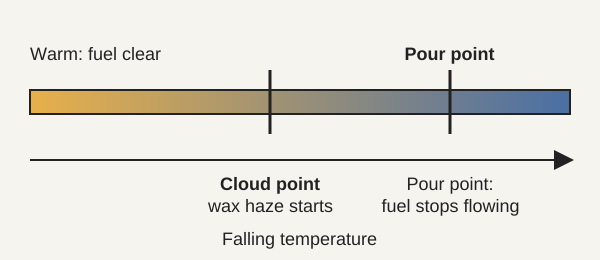
Diesel fuel gelling is wax crystals forming in cold fuel until they clog filters or stop it flowing. There is no single gelling temperature: it depends on the fuel, so ask your fuel supplier for the winter blend you are buying. The cloud point is where crystals first appear and the pour point is where fuel stops flowing. Follow your manual's winter fuel guidance.
Safety first
Keep open flame, sparks and any heat source away from diesel fuel, and do not try to thaw a fuel system with a flame or an unapproved heater. If you suspect gelled fuel, stop cranking and see a qualified technician; fuel leaks or work that opens fuel lines are technician jobs.

This is part of: How to Start a Diesel in Cold Weather
Diesel fuel gelling is what happens when wax in diesel fuel crystallizes in the cold and starts to block the filter or stop the fuel flowing. It is one part of cold-weather starting, so read how to start a diesel in cold weather with this page. We give no single gelling temperature, because none of the sources we opened supports one. Check your owner’s manual for fuel guidance.
What is diesel gelling?
Gelling is the end of a cold slide. The DOE-hosted NREL handling guide says that, unlike gasoline, diesel fuels and biodiesel can freeze or gel as the temperature drops, that gelling fuel can clog filters on dispensing equipment and may eventually become too thick to pump. It also says that below the cloud point, crystals might plug filters.
Cloud point, CFPP and pour point
Three terms come up. All three are defined or described in the DOE-hosted guide.
| Term | What it means | Source |
|---|---|---|
| Cloud point | Temperature at which small solid crystals are first visually observed as fuel is cooled; below it they might plug filters | NREL guide |
| Pour point | Temperature at which the fuel contains so many agglomerated crystals it is essentially a gel and will not flow | NREL guide |
| CFPP (cold filter plugging point) | Temperature at which a standard volume of fuel can be pulled by vacuum through a filter in a given time | NREL guide |
The guide adds that distributors and blenders use pour point as an indicator of whether fuel can be pumped, even if it would not be suitable for use at that temperature for most diesel engine applications. Do not treat the pour point as a safe limit.
Why there is no universal gelling temperature
A note in an ASTM table reprinted in the DOE-hosted guide says it is unrealistic to specify low-temperature properties that ensure satisfactory operation at all ambient conditions, and that appropriate properties should be agreed between the fuel supplier and the purchaser for the expected temperatures. The same note says satisfactory operation below the cloud point (or wax appearance point) may be achieved depending on equipment design, operating conditions and the use of flow improver additives. That is why a chart of one temperature for all diesel is misleading.
Winter blends: ask the supplier
Winter fuel is a matter for your supplier. The guide notes that biodiesel blends from B6 to B20 can be made with No. 1, No. 2 or mixtures of No. 1 and No. 2 petroleum fuel, as is common in cold weather. Your maker may limit the choice: the 2019 Ram 2500/3500/4500/5500 diesel supplement says No. 1 ultra low sulfur diesel should only be used where extended arctic conditions of -10 F (-23 C) exist, and limits biodiesel to 5% or 20% depending on the model. the 2019 Ram 1500 Classic 3.0L diesel supplement adds that a 12 volt heater built into the fuel filter housing aids in preventing fuel gelling.
Signs of gelling
The sources we opened do not list engine symptoms of gelled fuel, so we list none. The signs of a no-start or poor running also fit other faults, such as water in fuel, so do not self-diagnose. Stop cranking and ask a qualified technician.
Prevention and what to read next
Prevention starts with buying fuel suited to your area and following your manual. For the block heater side of cold weather, see engine block heaters. The cold-weather diesel guide walks through fuel and start-up choices by temperature, and diesel engines explained gives the wider background.
Answers to common questions
At what temperature does diesel gel?
There is no single temperature. An ASTM note reprinted in the DOE-hosted guide says it is unrealistic to specify low-temperature properties that ensure satisfactory operation in all ambient conditions, so the right figure depends on the fuel and the conditions. Ask your fuel supplier for the cloud point of the winter blend you are buying, and see your manual for fuel guidance.
Does biodiesel gel sooner?
Generally yes. AFDC says high-level biodiesel blends can gel in cold temperatures, and the NREL handling guide says the cloud point of biodiesel is generally higher than that of petroleum diesel. The guide also says B100 gels at higher temperatures than most diesel fuel and heating oil. The Ram diesel supplement limits biodiesel to B5 or B20 depending on the model, so check your manual.
Can gelled fuel damage the engine?
The sources we opened describe the main problem as clogged filters, with fuel that may eventually become too thick to pump. We found no source that quantifies engine damage from gelled diesel, so we make no claim beyond that. If you suspect gelled fuel, do not keep cranking, and call a qualified technician who can check the filter and fuel.
What is the difference between cloud point and pour point?
Cloud point is where small wax crystals first become visible as the fuel cools, and below it they can plug filters. Pour point is lower: the fuel has so many agglomerated crystals that it is essentially a gel and will not flow. Fuel can cause trouble between the two, so the pour point is not a safe operating limit.
Do fuel additives fix gelling?
We make no efficacy claim for additives. The ASTM note quoted in the DOE guide says satisfactory operation below the cloud point may be achieved depending on equipment design, operating conditions and the use of flow improver additives. A Ram 2500/3500/4500/5500 diesel supplement says commercial additives are not necessary for its Cummins diesel. Follow your maker's guidance and quote any additive claim to its maker's data sheet.
Sources
- U.S. DOE Alternative Fuels Data Center: Biodiesel Blendsafdc.energy.gov
- 2019 Ram 2500/3500/4500/5500 6.7L Diesel Supplement: diesel fuel requirementsvehicleinfo.mopar.comp. 131
- 2019 Ram 1500 Classic 3.0L Diesel Supplement: Extreme Cold Weathervehicleinfo.mopar.comp. 33
Worth reading next
- How to Start a Diesel in Cold Weather
Start a diesel in the cold the way the manual says: wait-to-start lamp, cranking limits, battery, block heater, fuel, and why starting fluid is a no.
- Engine Block Heaters: How They Work and When to Use One
What an engine block heater is, how it warms coolant for easier cold starts, and how to check your manual for when to plug in and which cord to use.
- Block Heater Cords and Extension Cords: Safe Use
Block heater cord and extension cord checklist from owner's manuals and OSHA: grounded three-wire cords, GFCI outlets, damage signs, and when to stop.
- Diesel Engine Block Heater: Trucks, Tractors and Generators
How a block heater helps a diesel truck, tractor or generator start in the cold, what two Ram manuals say about plug-in time, and why your manual rules.