How to Prevent Diesel Fuel Gelling in Winter
- Written by
- Diesel Glow Plug Editorial Team
- Reviewer
- Diesel Glow Plug Editorial Team
- Review date
- First published
To prevent diesel fuel gelling, buy fuel whose cloud point suits the lowest temperature you will see, and get winter blending in before wax forms. Engine makers say to use climatized or blended winter fuel in the cold, treat additives as a limited help, and follow your manual's fuel grade and any built-in filter heater.
Safety first
Diesel fuel is flammable. Keep sparks and flames away when handling fuel or blending, and never use gasoline or alcohol as a blending agent. Anything that opens a fuel line or fuel filter housing is a job for a qualified technician.

This is part of: How to Start a Diesel in Cold Weather
Preventing diesel fuel gelling comes down to one idea: keep wax from forming where it can plug the filter. That means choosing fuel that suits the coldest weather you expect, blending before wax appears, and using the heaters and fuel grades your maker lists. The background is in diesel fuel gelling basics, and the wider winter routine is in how to start a diesel in cold weather. Check your owner’s manual first.
Match the fuel to the coldest weather
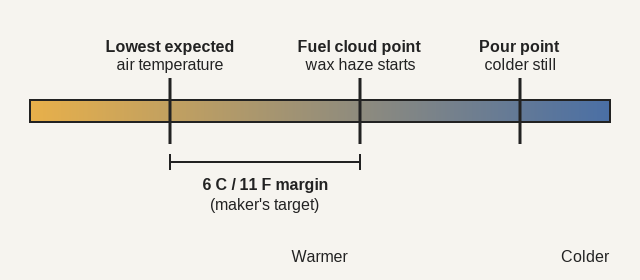
Cummins’ bulletin sets a clear target: the fuel’s cloud point should be 6 degrees C (11 degrees F) below the lowest ambient temperature at which it will operate. It also recommends premium diesel in winter at -7 degrees C (20 degrees F) or below. Only the supplier knows the cloud point of the fuel you are buying, so ask. No chart of one gel temperature for all diesel is reliable; NREL’s guide quotes an ASTM note saying it is unrealistic to specify one set of low-temperature properties for all conditions.
Winter blends and the 50 percent rule
Cummins says the most common prevention is to dilute heavier No. 2 diesel with lighter No. 1 diesel or jet fuel. A typical blend holds 30 to 60 volume-percent of the light fuel and lowers the cloud point about 3 to 7 degrees C (5.4 to 12.6 degrees F) and the pour point 5 to 11 degrees C (9 to 20 degrees F). Cummins adds that blended fuel costs more to use and has a lower energy content, and that the light fuel must be added before wax forms.
The Ram supplement we opened is narrower and more practical. For its Cummins engine below 20 degrees F (-7 degrees C), or if it works in colder-than-normal conditions for long periods, it says to use climatized No. 2 diesel or dilute No. 2 with 50 percent No. 1. It says No. 1 ultra low sulfur diesel should be used alone only in extended arctic conditions. Its own fuel chart and specification page quote different arctic figures (0 degrees F and -10 degrees F), a good reason to read your manual rather than a summary. The chart also notes a noticeable drop in fuel economy on climatized or No. 1 fuel.
Check the pump label
Ram says the fuel grade should be clearly marked on the pump. If the pump does not say, ask the retailer. It is the supplier, not a dashboard, that knows what is in the tank.
Fuel filter heaters
Some vehicles have built-in help. The Ram supplement says a 12-volt heater in the fuel filter housings, controlled by a thermostat, aids in preventing fuel gelling. Cummins says vehicles designed for very low temperatures can have heated fuel tanks, insulated lines and heated filters, but that these are usually not practical in temperate climates where they are needed only a few days a year. Your owner’s manual says whether your vehicle has any of these. Do not add a heater to the fuel system yourself; Cummins says problems traced to fuel system modifications are not covered by its warranty.
Where additives fit
Winter additives (pour point depressants, cold flow improvers, wax crystal modifiers) change the size and shape of wax crystals so fuel can be pumped at lower temperatures, according to Cummins. It says certain additives can lower the pour point as much as 21 degrees C (70 degrees F), but that they are not a cure-all, their effect varies with the fuel, and severe weather can need warmers in addition. It also advises asking your fuel supplier whether the fuel already carries one before you buy another. Ram’s supplement says additives are not necessary for its Cummins engine, though it mentions an equivalent treatment where seasonal fuel is not available below 20 degrees F. We name no product and compare none. If you use one, quote its maker’s data sheet and check your manual allows it.
Biodiesel needs more care
NREL says B100 gels at higher temperatures than most diesel and that cold flow additives work much better in blends than in B100. A Ram supplement allows up to 5 percent biodiesel (B5) for some models and up to 20 percent (B20) for others, and warns biodiesel may gel or solidify at low temperatures, naming heated storage or cold temperature additives as precautions. Check which your engine allows.
Checklist
- Know the lowest forecast temperature and the fuel’s cloud point from the supplier.
- Use the fuel grade your manual lists, and winter or climatized fuel in the cold.
- Blend before wax forms, never with gasoline or alcohol.
- Do not rely on an additive alone.
- Follow your manual’s guidance on filter heaters and water drains.
- If fuel does gel, do not keep cranking; see how to fix gelled diesel fuel.
The Cummins block heater guide shows one maker’s cold-start equipment, and the cold-weather diesel guide lines up your forecast against the cloud point you enter, and engine block heaters cover the starting side of winter.
Answers to common questions
How do you keep diesel fuel from gelling?
Start with fuel suited to the lowest temperature you expect. Cummins specifies a cloud point at least 6 degrees C (11 degrees F) below the lowest ambient temperature, and the supplier knows the cloud point of what is in the pump. Then follow your manual: winter blends, any built-in fuel filter heater and its guidance on additives. Blending must happen before wax forms.
Can I just add No. 1 diesel or kerosene myself?
The makers describe the method but you should check your own manual. Cummins says the most common prevention is diluting No. 2 with lighter No. 1 or jet fuel, and that the lighter fuel must go in before wax forms. Ram gives its own 50 percent No. 1 limit for its supplement's engine. Do not use gasoline or alcohol, which Ram says can be explosive in diesel.
Do anti-gel additives work?
We make no efficacy claim. Cummins says winter additives alter wax crystal size and shape and certain ones lower the pour point by up to 21 degrees C (70 degrees F), but they are not a cure-all and results depend on the fuel. Cummins also says to ask the supplier whether the fuel already contains one. Ram says additives are not necessary for its Cummins engine.
Does a block heater stop fuel from gelling?
None of the sources we opened say so. The block heater warms engine coolant for starting. The Ram supplement lists a separate heater built into the fuel filter housing as the part that aids in preventing gelling on its engines. Check your own manual for which heaters your vehicle has and what each does.
Is winter diesel at the pump already blended?
Often, but ask. The Ram supplement says climatized fuel is a blend of No. 2 and No. 1 ultra low sulfur diesel that lowers the temperature at which wax crystals form, and that the grade should be clearly marked on the pump. Cummins cites an old Bureau of Mines survey in which a large share of commercial diesels had been treated with a winter additive. Ask the supplier for the cloud point.
Sources
Worth reading next
- How to Start a Diesel in Cold Weather
Start a diesel in the cold the way the manual says: wait-to-start lamp, cranking limits, battery, block heater, fuel, and why starting fluid is a no.
- Engine Block Heaters: How They Work and When to Use One
What an engine block heater is, how it warms coolant for easier cold starts, and how to check your manual for when to plug in and which cord to use.
- How to Fix Gelled Diesel Fuel: What the Makers Say
What to do about gelled diesel fuel: wax versus ice, why cranking and gasoline are bad ideas, and what engine makers say before you call a technician.
- Block Heater Cords and Extension Cords: Safe Use
Block heater cord and extension cord checklist from owner's manuals and OSHA: grounded three-wire cords, GFCI outlets, damage signs, and when to stop.
- Diesel Engine Block Heater: Trucks, Tractors and Generators
How a block heater helps a diesel truck, tractor or generator start in the cold, what two Ram manuals say about plug-in time, and why your manual rules.
- Diesel Fuel Gelling: Temperatures, Signs and Basics
What diesel fuel gelling is, how cloud point and pour point differ, why no single temperature applies, and what makers and DOE sources say on winter fuel.