Heavy-Duty Diesel Engine Oil: CK-4, FA-4 and Approvals
- Written by
- Diesel Glow Plug Editorial Team
- Reviewer
- Diesel Glow Plug Editorial Team
- Review date
- First published
Heavy-duty diesel engine oil is oil carrying an API C-series category such as CK-4 or FA-4. CK-4 is designed to exceed older CJ-4 and CI-4 oils, but FA-4 is not backward compatible with any of them. Which one you may use is set by your owner's manual or the engine maker's service data, not by the label alone.

This is part of: Diesel Engine Oil: Viscosity, Specs and How to Choose
Heavy-duty diesel engine oil is oil rated under API’s diesel (C-series) categories. For the overall picture, start with the diesel engine oil guide; this page covers what CK-4, FA-4 and maker approvals mean and where the limits are.
What the service categories mean
API publishes separate charts for gasoline engines (S-series, such as SP and SN) and diesel engines (C-series, such as CK-4 and CJ-4). Oils may have more than one performance level, and for diesel engines the latest category usually, but not always, includes the properties of an earlier category.
The viscosity grade, such as 15W-40, is a separate label. SAE J300 covers viscosity only; our 15W-40 guide explains that split.
Backward compatibility, from API’s own wording
| Category | What API says | Fuel sulfur note from API |
|---|---|---|
| CK-4 | Exceeds the performance criteria of CJ-4, CI-4 with CI-4 PLUS, CI-4 and CH-4 | Formulated for fuels up to 500 ppm sulfur; consult the engine maker about service intervals above 15 ppm |
| CJ-4 | Exceeds the performance criteria of CI-4 with CI-4 PLUS, CI-4, CH-4, CG-4 and CF-4 | Above 15 ppm sulfur, may affect aftertreatment durability or drain interval; consult the engine maker |
| FA-4 | Not interchangeable or backward compatible with CK-4, CJ-4, CI-4 PLUS, CI-4 and CH-4 | Not recommended with fuels above 15 ppm sulfur |
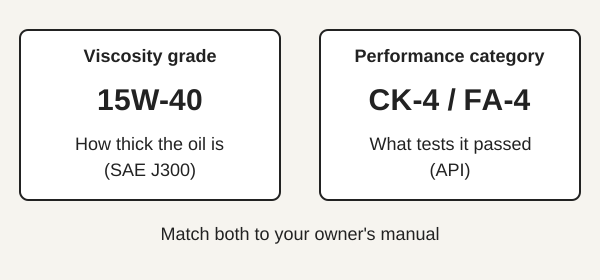
Maker approvals
Some engine makers publish their own approvals or specifications in the manual or service data. We did not open any maker approval list for this guide, so we do not name approvals. If your manual names one, the container must show it.
What to avoid: guessing
- Do not choose FA-4 because it is newer; API says it is not backward compatible.
- Do not assume an older manual’s category is obsolete. GM told dealers in 2017 that its manuals named CJ-4, which was no longer available, so ask the maker or a technician what replaces it.
- Do not ignore the fuel sulfur notes above.
How to use this page at the parts counter
- Write down the category, viscosity grade and any maker approval from your manual.
- Compare each against the container label, one line at a time.
- If a container lists several categories, confirm that the one your manual names is among them.
- If your manual names an older category, ask the counter or a technician which category replaced it.
Common mistakes: assuming a newer category always suits an older engine, ignoring a maker approval, and choosing by price or by a “heavy duty” label alone.
When to stop and ask a technician
- Your manual’s category no longer appears on any container.
- You are unsure whether the engine tolerates FA-4.
- Oil pressure or engine warning lights are on.
Related guides
Answers to common questions
Can CK-4 replace CJ-4?
API states that CK-4 oils exceed the performance criteria of CJ-4, so CK-4 is the category designed to follow it. General Motors also told dealers in 2017 that manuals calling for CJ-4 referred to an oil no longer available, and pointed to CK-4. Confirm it in your own manual or with the engine maker before you switch.
What is FA-4?
FA-4 is an API diesel oil category that API says is not interchangeable or backward compatible with CK-4, CJ-4, CI-4 PLUS, CI-4 and CH-4. API also does not recommend it with fuels above 15 ppm sulfur. Use it only if your engine maker specifically calls for it in the manual or service data.
Do pickups need heavy-duty oil?
A diesel pickup uses a diesel category such as CK-4 only if its manual says so. Some pickups specify a diesel category, others a maker approval, and the manual overrides general advice. Read the oil section for your exact model and year, and ask a technician if the printed category is no longer sold.
Does the label tell me everything I need?
No. The API category is one part, the viscosity grade is another, and some engine makers add their own approvals. SAE J300 covers viscosity only and says other oil characteristics are not considered. Compare every item on your manual's oil specification with the container before buying.
Is a newer category always better?
Not automatically. API says the latest diesel category usually, but not always, includes the properties of an earlier one, and FA-4 is the clear example, as it is not backward compatible with CK-4. Choose the category your manual names, not the newest one on the shelf.
Sources
Worth reading next
- Diesel Engine Oil: Viscosity, Specs and How to Choose
How to read diesel engine oil: API CK-4 and FA-4 categories, why your manual's grade comes first, and what to check before you buy. No brand rankings.
- 15W-40 Diesel Oil: What the Numbers Mean and When to Use It
15W-40 diesel oil explained: what the SAE grade does and does not tell you, how API CK-4 and FA-4 fit in, and why your manual decides.
- Can You Use Regular Car Oil in a Diesel Engine?
Whether gasoline-engine oil suits a diesel depends on its API category. Learn what the S and C labels mean and what your manual requires.
- Diesel in a Gas Engine: What Happens and What to Do
Filled a gasoline car with diesel? Do not start it. What to do first, who to call, and how to avoid grabbing the wrong nozzle again.
- Gas in a Diesel Engine: What Happens and What to Do
Put gasoline in a diesel tank? Do not start the engine. What a manufacturer manual says, why it matters, and who to call.